
Who Is Jeremy Griffith?
The following are the first two paragraphs of Jeremy Griffith’s biography on HumanCondition.com
The Australian biologist Jeremy Griffith has dedicated his life to bringing fully accountable, biological explanation to the dilemma of the human condition — how do we explain our species’ extraordinary capacity for what has been called ‘good’ and ‘evil’. While it’s undeniable that humans are capable of great love and empathy, we also have an unspeakable history of greed, hatred, rape, torture, murder and war; a propensity for deeds so shocking and overwhelming that the eternal question of ‘Why?’ seems depressingly inexplicable. Even in our everyday behaviour, why, when the ideals of life are to be cooperative, selfless and loving, are we so ruthlessly competitive, selfish and aggressive that human life has become all but unbearable and our planet near destroyed? How could humans possibly be considered good when all the evidence seems to unequivocally indicate that we are a deeply flawed, bad, even ‘evil’ species? (For further description of what the human condition is, see The Human Condition summary written by Jeremy Griffith, or Jeremy’s 2022 presentation The Great Guilt that causes the Deaf Effect, and FAQ 1.1.)
For most people, trying to think about this ultimate of questions of whether humans are fundamentally good or not has been an unbearably self-confronting exercise. Indeed, while the term ‘human condition’ has become fashionable, its superficial use masks just how profoundly unsettling a subject it really is. Again, the truth is the issue of the human condition has been so depressing for virtually all humans that only a rare few individuals in history have been sound and secure enough in self to go anywhere near what the human condition really is. (Again, see The Human Condition summary; also Video/Freedom Essay 11 on the difficulty humans have had engaging with the subject of the human condition, including analysis of Plato’s cave allegory.) So for Jeremy to so freely and accurately talk about it as he does in FREEDOM, he clearly must be one of those rare few. Nurtured by a sheltered upbringing in the Australian ‘bush’ (countryside), Jeremy’s soundness and resulting extraordinary integrity and thus clarity of thought, coupled with his training in biology, has enabled him to successfully grapple with this most foreboding of all subjects for the human mind of the human condition and produce the breakthrough, human-behaviour-demystifying-and-ameliorating explanation of it.
My personal appreciation for who Jeremy Griffith is and the unfathomable importance of his work
Over time, I’ve come to deeply appreciate the profound responsibility Jeremy carries as the custodian of this world-saving understanding of the human condition. He lives in service of the truth every moment, because the complete and compassionate explanation he’s provided truly holds the key to ending humanity’s suffering and saving the world. For that reason, it is the most precious gift on Earth. What I find especially admirable is Jeremy’s unwavering dedication to living and disseminating this truth in a world that has long struggled to hear and embrace it. The understanding he presents brings a major shift in our understanding of human life, and although it’s ultimately an immensely positive change, it can naturally feel confusing and confronting at first. But with time and patience, it becomes clearer, and its compassion, clarity and life-transforming qualities begin to become accessible. With this clearer access comes a deeper appreciation for just how important, precious and profound a breakthrough it is for humanity. Ultimately, it offers us all a safe and gradual way to step out of the awful darkness we’ve heroically been living in and into the light of self-understanding and freedom from the human condition. What inspires me most is how Jeremy continues to protect and uphold this understanding with such empathy, even in the face of immense resistance and denial. He understands that the deaf effect is an unavoidable first response to something so honest and unevasive. While he must remain strong in the face of this resistance to preserve the integrity of this information, he always responds with empathy and compassion.
That is the power of this understanding. It doesn’t judge or condemn, it compassionately explains. It finally gives us the means to make sense of ourselves and to find peace, which is what the world really needs to and enable us to fix everything up and ultimately bring us all back together again as the united ‘Specie Individual’ we truly are deep down. A saying Jeremy often uses is “if we look after this understanding, it will look after us and the world”. Jeremy embodies those words and shows us all that it’s possible, and the most hopeful part is that with time and care, we can all follow that example and experience the deep freedom and relief it brings.
Further background from Jeremy Griffith’s extraordinary life dedicated to solving the human condition
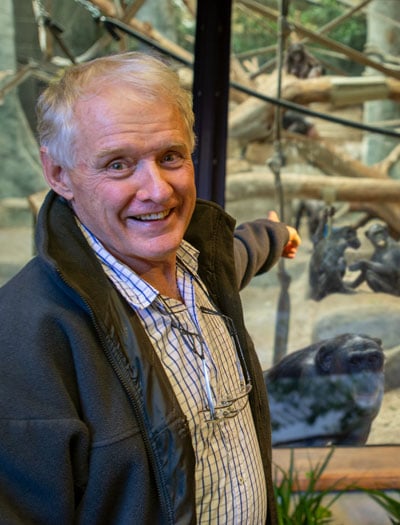
Australian biologist Jeremy Griffith was raised on a sheep station in rural New South Wales and educated at Geelong Grammar School in Victoria, one of the most highly regarded schools in the world. Jeremy gained first class honours in biology in the state matriculation exams, and in 1965 began a science degree at the University of New England in northern New South Wales. While there, Jeremy played representative rugby union football, making the 1966 trials for Australia’s national team, the Wallabies.
Deferring his studies in 1967, Jeremy hitchhiked to Tasmania, determined to save the remarkable dog-like marsupial, the Thylacine, or ‘Tasmanian Tiger’, from extinction. The search was to last more than six years — the most thorough investigation ever into the plight of the Tasmanian Tiger — but sadly concluded it was extinct. The quest generated articles in the American Museum of Natural History’s journal, Natural History, and Australian Geographic, and featured in an episode of the Australian television series A Big Country.
In 1971 Jeremy completed his BSc in zoology at the University of Sydney and the following year, in the same self-sufficient spirit with which he had undertaken the ‘Tiger’ search, he established Griffith Tablecraft, a highly successful business manufacturing furniture based on his own simple and natural designs. In addition to his design work, Jeremy is also an accomplished artist.
It was during this time that, at age 27, Jeremy realised that trying to save animals from extinction or trying to build ideal furniture wasn’t addressing the real issue behind the extraordinary imperfection in human life, which is our species’ ‘good and evil’-conflicted behaviour, and that what was really needed in the world was a deeper understanding of ourselves — so it was to this issue of the human condition that Jeremy turned his attention, a study that has remained his life’s focus.
Jeremy started writing about the human condition in 1975, established the World Transformation Movement (WTM) in 1983 (which is dedicated to the study and amelioration of the human condition), and is the author of numerous books on the subject, including the 2004 bestseller A Species In Denial, and in 2016, FREEDOM: The End Of The Human Condition, his “summa masterpiece”.
Jeremy’s full biography is available on HumanCondition.com.